
ISOlDE – from a prototype to an engine, an IDE with plugins and a tested tool chain.
What is being built here is not vibe coding in the usual sense. It is the interplay of three things:
A developer with 45 years of software development behind them: architecture, domain knowledge and every decision rest with them – not with the AI.
FDK, D.MVVM, FMX ribbon controls and the FMX source code editor were already in the portfolio. ISOlDE does not start from zero but on a solid foundation.
The outstanding performance of Claude Code only comes into its own through our enterprise backend server strategy: MCP servers for compiler, plans, tests and search, communication between the agents and a ProxyMCP that makes it possible to coordinate several agents in the first place.
Claude suddenly surprised me with a new feature: before changing the real software, he always creates an HTML page first. I knew that from before – but that these small preview web pages are fully functional was new: right up to a sprite editor you can already really paint with, and real 3D views with motion. That blew me away.
The result is not throwaway code but traceable, tested software: every feature is in the feature list with its evidence, every change in the history, and the IDE self-test continuously checks that everything holds.
Recorded on 28 September 2026 – days 1 to 3 (26–28 Sep), plus the start on 25 Sep:
New repository for the engine, resources imported, the runner runs without Direct2D. The prototype is finished, the actual engine starts here.
Mesh render path with GPU skinning (up to 256 bones), content store (content-addressed, compressed), scene designer with tiles and objects, command layer with undo/redo. Game code as a DLL with hot reload: the IDE builds, starts and swaps it on save. The runner sits as a child in the IDE window.
Shader graph with 47 nodes, HLSL code generation and compute tests (also on the software rasterizer), height levels, ramps and stairs, flow surfaces for water and lava, sprite import and sprite baking, asset package, first demo scenes (volcano island, an arcade-classic style course), splash screen, the plugin interface for IDE extensions and the sprite editor as a plugin.
Plugin host in the IDE, standalone sprite editor as a second application, per-pixel depth image for sprites, baked shader materials as tile materials. The volcano island gets grass in the wind, wooden bridges, flowing lava and smoke. Dynamic light with time of day, surface tools in the sprite editor, screenshot key, the feature list and version 0.5.0.
What was added in the following days (29–30 Sep):
Ribbon with tabs in their own colour, tooltips and hint line, info tab with licences and news, recording mode, game inspector, project switching without restart, shader catalogue for shader model 5, connection for AI agents (asset semantics, tool catalogue) and a staged self-test that grows to 2,299 checks without a failure by 30 Sep.
Before building, we sketch: clickable drafts, material studies and comparisons. These pages are interactive – a click opens them right here.
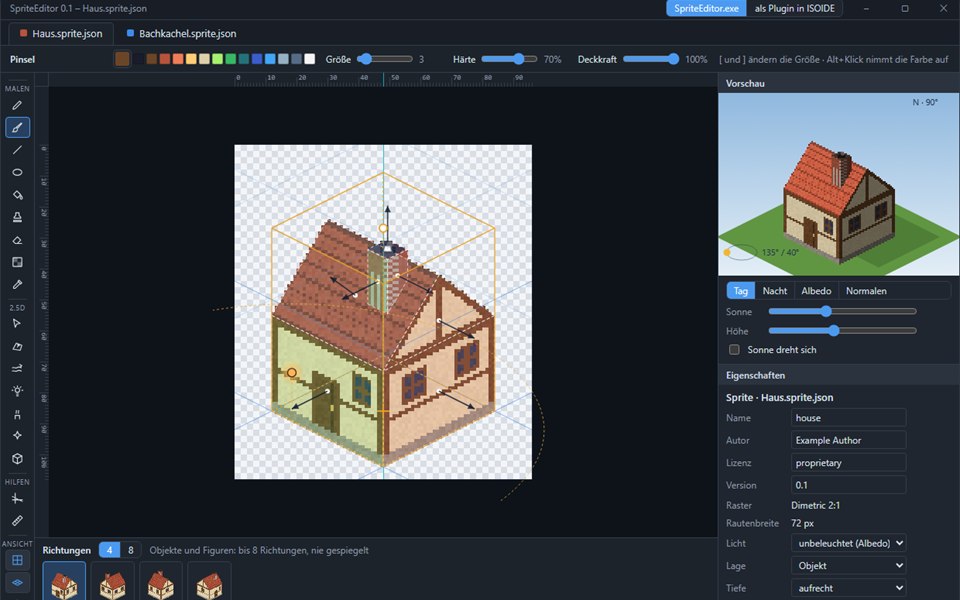
Working sketch of the pixel and 2.5D editor: surfaces and normals, flow areas, light points, emitters and a light-test preview.
2026-09-27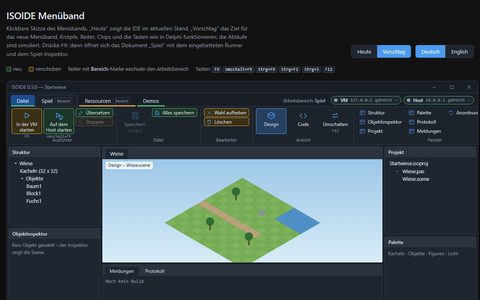
Clickable sketch of the ribbon with the “Today” and “Proposal” variants, backstage page, runner chips and an embedded game document.
2026-09-26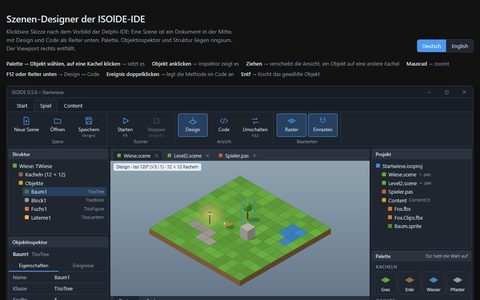
Clickable sketch of the scene designer: a scene as a document, design and code pages, palette, object inspector and structure.
2026-09-26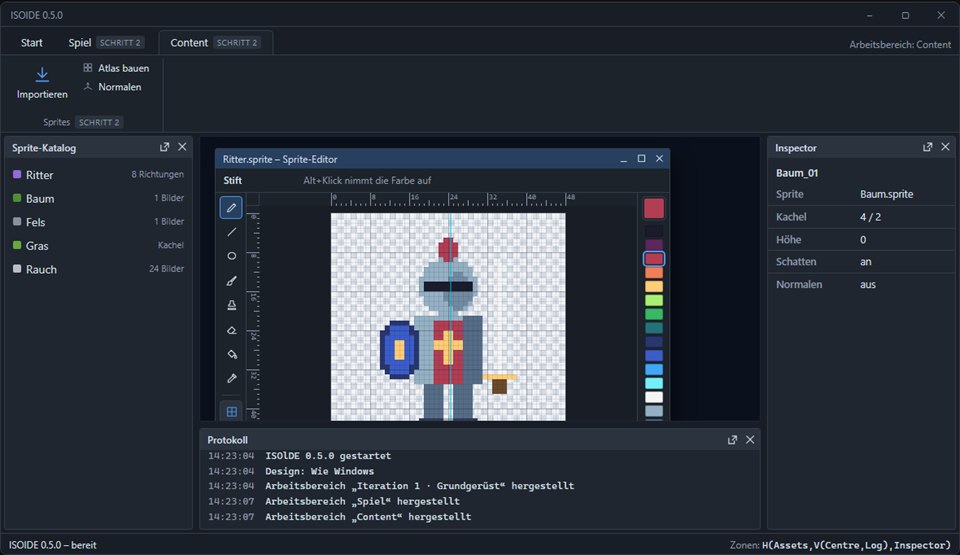
Tool windows dock to the edges or float, editors live as document windows in the centre.
2026-09-25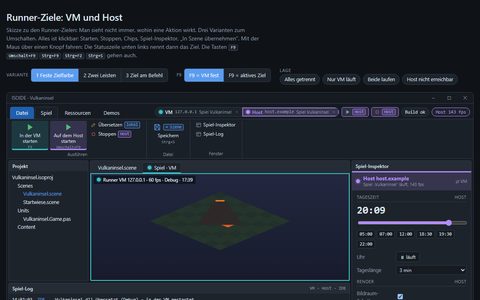
Three variants showing how the VM and host runners are made recognisable as the target of start, stop and inspector.
2026-09-28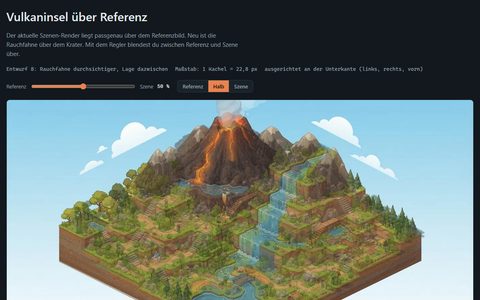
The scene render of the volcano island cross-faded over the reference image with a slider – with smoke plume, rock mountains and flowing lava.
2026-09-28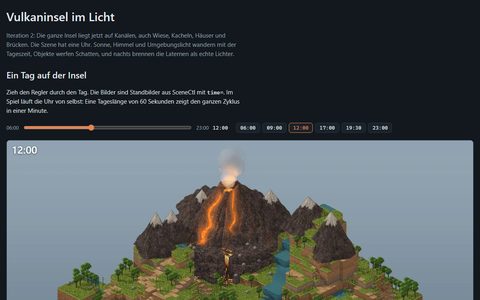
Time-of-day slider, cast shadows and lantern light on the volcano island.
2026-09-28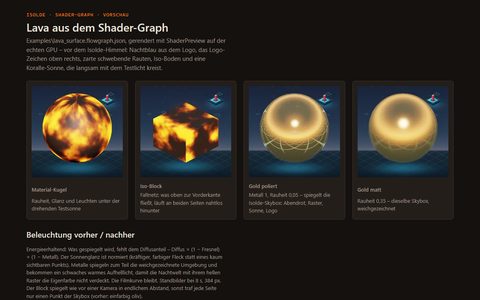
Animated lava surface on a sphere and an iso block, plus gold and plastic material tests with lighting before/after.
2026-09-27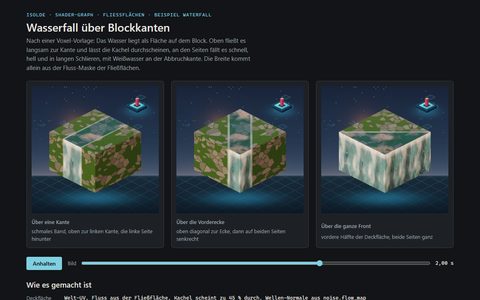
An animated shader-graph waterfall in three widths together with a breakdown of its layers.
2026-09-27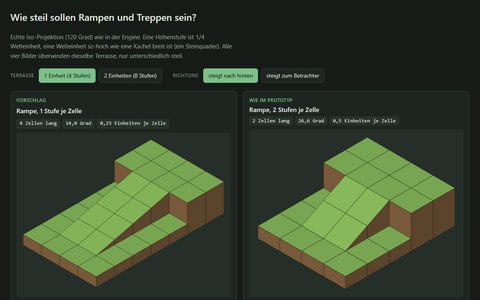
Four isometric views: how steeply ramps and stairs (1–4 steps per cell) climb the same terrace.
2026-09-27
Eleven local language models write nine shader tasks for the engine, checked with the compiler and rated for correctness.
2026-09-27
Catalogue of the 37 tools an AI agent can use in ISOlDE – filterable by layer and profile.
2026-09-29 DelphiProfi.de
